In This Article
- Why Indian Wedding Photography Stands Apart
- The Power of Colour in Indian Celebrations
- Emotion That Cannot Be Staged
- Traditions That Tell a Story
- A Photographer’s Honest Perspective
- Why Specialization Matters
- Frequently Asked Questions
Why Indian Wedding Photography Stands Apart
I have photographed hundreds of weddings over the years. Western ceremonies, intimate elopements, destination celebrations, backyard gatherings. And I love every single one of them. However, there is something about Indian weddings that changed me as a photographer. Once you experience the scale, the emotion, and the sheer visual richness of an Indian celebration, your entire understanding of what a wedding can be shifts permanently.
Let me explain what I mean. A typical Western wedding lasts about six to eight hours. You have the ceremony, the cocktail hour, the reception, and you are done by midnight. An Indian wedding, on the other hand, can stretch across three, four, or even five days. Each day brings a completely different event with its own rituals, its own energy, and its own visual world. As a result, the photography demands are on an entirely different level.
In fact, according to WeddingWire Canada and industry reports from The Knot, the average Indian wedding in Canada costs over $100,000 — more than double the national average of $39,000 for all weddings. That investment reflects the depth and significance these celebrations hold for families. And the photography needs to match that level of care and intention.
| Stat | Figure | Source |
|---|---|---|
| Average Indian Wedding Cost in Canada | $100K+ | WeddingWire Canada, 2025 |
| Couples Who Rank Photography #1 | 34% | The Knot, 2025 |
Moreover, 34% of couples rank photography as their number one budget priority. For Indian families, that percentage is even higher in my experience. When you are investing this much love, time, and money into a celebration, you want every single moment preserved beautifully.
The Power of Colour in Indian Celebrations
Here is something that non-Indian wedding photographers often do not fully appreciate: colour is not decoration at an Indian wedding. It is language. It carries meaning. It tells a story.
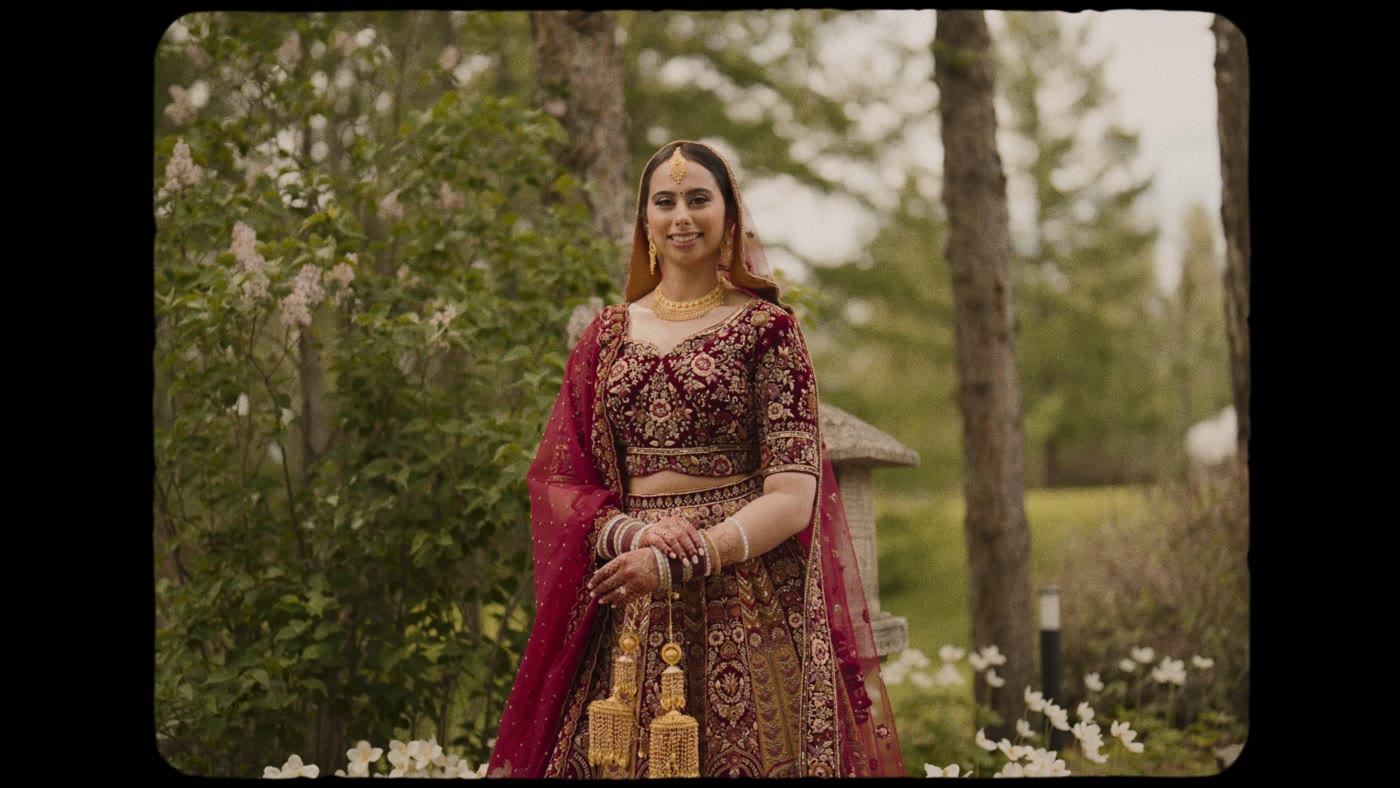
The red of the bride’s lehenga symbolizes prosperity and new beginnings. The yellow of the haldi turmeric represents purification and blessings. The green in the mehndi signifies fertility and joy. The gold in the jewellery represents wealth and divine blessings. Every colour you see at an Indian wedding was chosen with intention.
For example, during a Punjabi wedding I photographed last summer, the bride wore five different outfits across three days. Each one was a completely different colour palette. The mehndi outfit was a soft mint green with gold embroidery. The sangeet dress was a deep midnight blue covered in crystals. The wedding day lehenga was classic red and gold. The reception gown was a blush pink with silver detailing. And each outfit was styled with completely different jewellery and accessories.
As a photographer, this means you are essentially shooting five different visual stories within one celebration. The lighting approach changes. The backgrounds you choose change. The colour theory of your compositions changes. It is challenging, yes. However, it is also what makes the final gallery so breathtakingly varied and beautiful.
Photographer Tip
When photographing Indian wedding attire, pay attention to how light interacts with different fabrics. Silk reflects light differently than velvet or georgette. Sequins and mirror-work create their own light sources. Understanding these textures helps you choose the right exposure and angle for every outfit.
The venue decor at Indian weddings is equally stunning. Mandaps draped in flowers, stages covered in candles, centrepieces that are works of art. The attention to visual detail is extraordinary. In addition, Indian families often hire dedicated decor teams who spend days transforming venues into something out of a dream. As a photographer, walking into a fully decorated Indian wedding venue is like walking into a film set. Every corner is photogenic.
That said, all this visual richness creates a unique challenge. With so much happening in every frame, the photographer needs to know what to focus on. You cannot just point and shoot. You need to compose carefully, balance the colours, and make sure the people — the real subjects — are not lost in the visual spectacle. It takes practice and experience to get this right consistently.
Emotion That Cannot Be Staged
I have a confession. I have cried behind my camera at Indian weddings. More than once. And I am not embarrassed about it.
The emotional depth of Indian wedding traditions is unlike anything else I photograph. The vidaai, for instance, is the moment when the bride leaves her parents’ home. Her mother is holding her, crying. Her father is trying to stay strong but failing. Her siblings are clutching her hands. The entire family is openly, unashamedly emotional.
In Western culture, there is sometimes a pressure to keep emotions contained at weddings. To look happy and composed. At Indian weddings, emotions flow freely. Joy, tears, laughter, love — everything is expressed without filter. As a result, the photographs carry a rawness and authenticity that is incredibly powerful.
Meanwhile, the baraat — the groom’s procession — is the polar opposite of the vidaai. It is pure, unrestrained joy. The groom arrives at the venue and his entire family is dancing around him. Dhol drummers are pounding out beats that shake your chest. People are singing, jumping, throwing petals. It is a moving party that sweeps through the parking lot and into the venue.
I have photographed baraats in the middle of Edmonton streets, in hotel lobbies, and in banquet hall parking lots. Every single one was magic. The energy is so high that it carries you along. You are dancing while you shoot. You are grinning behind the lens. The photos from baraats are consistently among the most joyful images in any gallery I deliver.
Indian weddings do not just show emotion — they celebrate it. Every tear, every laugh, every shout of joy is a sacred part of the story. That is why these photographs matter so much.
Of course, the ceremony itself carries its own emotional weight. The pheras around the sacred fire, the exchange of garlands, the moment when the bride and groom truly see each other for the first time. These are spiritual moments. They carry centuries of meaning. And they happen once. There are no second takes. Your photographer either captures them or they are gone forever.
Traditions That Tell a Story
Every ritual at an Indian wedding has a purpose. Every gesture has meaning. And a photographer who does not understand these traditions will inevitably miss the moments that matter most.
For example, during a Hindu ceremony, the saptapadi — the seven steps — represents seven promises the couple makes to each other. Each step has a specific vow. A photographer who does not know this might treat the seven steps as a single moment and capture only one or two frames. However, a photographer who understands the tradition captures each step, because each one tells a different part of the couple’s commitment.
Similarly, during a Sikh Anand Karaj ceremony, each of the four Laavan represents a different stage of love. The Sikh Heritage Foundation provides excellent historical context on the Laavan and their spiritual significance. The first is duty and commitment. The second is courage and trust. The third is detachment from worldly desires. The fourth is the ultimate union. A photographer who understands this captures not just the physical act of circling the Guru Granth Sahib, but the emotional progression that unfolds across the four rounds.
Moreover, there are smaller traditions that carry enormous emotional significance. The chooda ceremony, where the maternal uncle gifts the bride her red and white bangles. The joota chupai, where the bride’s sisters playfully steal the groom’s shoes. The chunni ceremony, where the groom’s family welcomes the bride with a headscarf and gifts. Each of these moments is photogenic, meaningful, and brief.
For Couples
Share a timeline of your ceremonies with your photographer well in advance. Include the names of each ritual and a brief explanation. Even experienced Indian wedding photographers appreciate a refresher, because every family does things slightly differently.
In addition, regional variations add another layer of complexity. A Gujarati wedding has different traditions than a Punjabi wedding, which is different from a Bengali wedding, which is different from a South Indian wedding. Even within the same religion, customs vary significantly by region and family. This is why experience and cultural sensitivity matter so much in Indian wedding photography.
A Photographer’s Honest Perspective
I want to be real with you about something. Photographing Indian weddings is hard. It is physically demanding. It is mentally exhausting. And it is the most fulfilling work I do.
A typical three-day Indian wedding means I am on my feet for 10 to 14 hours each day. I am carrying heavy equipment up stairs, across venues, through crowds. I am adapting to lighting conditions that change from outdoor bright sun to dimly lit ceremony halls to strobe-filled dance floors — sometimes within the span of thirty minutes. I am managing two camera bodies, multiple lenses, and flash equipment while navigating through hundreds of guests.
On top of the physical demands, the mental challenge is significant. You need to anticipate moments, track multiple storylines, and stay sharp for hours on end. At any given moment during an Indian wedding, there might be three important things happening simultaneously. The bride’s mother is getting emotional while the groom’s family is dancing while the pandit is preparing for the next ritual. You need to make split-second decisions about what to capture.
Global Wedding Photography Market$26.9BFortune Business Insights, 2026
However — and this is important — the exhaustion is completely worth it. When I deliver a gallery from a three-day Indian wedding, it is easily the most diverse, most colourful, most emotionally rich body of work I produce. The images tell a story that spans days and encompasses every human emotion. Pride, joy, sorrow, love, laughter, devotion, mischief. It is all there.
The Professional Photographers of Canada (PPOC) recognizes wedding photography as a distinct specialization, but I always tell couples that Indian wedding photography goes even further. It is not a side skill. It is a specialization. The global wedding photography market is valued at $26.9 billion, and within that market, Indian and South Asian weddings represent one of the most demanding and rewarding niches. Photographers who excel at it have invested years in understanding the culture, the rituals, and the pace of these celebrations.
Why Specialization Matters
Here is a question I get asked often: can any good wedding photographer handle an Indian wedding? The honest answer is — probably not. At least not at the level your celebration deserves.
A good wedding photographer understands light, composition, and emotion. Those are universal skills. However, Indian wedding photography adds layers that require specific expertise. You need to know the traditions, the timeline, the pace, the key moments, the cultural significance of every ritual. You need to know where to stand during the pheras, when to shoot during the Laavan, and how to capture the baraat without getting trampled.
In addition, you need to understand how to work with Indian wedding lighting. Many ceremonies happen under mandaps with mixed lighting — daylight from windows combined with spotlights combined with the warm glow of the sacred fire. Sangeets are essentially nightclub lighting with DJ effects and strobes. Getting consistent, beautiful colour in these conditions takes experience and technical skill.
I specialize in Indian wedding photography because I believe these celebrations deserve a photographer who truly understands them. Not someone who is learning on your wedding day. Not someone who treats it like a regular wedding with more colours. Someone who has done this many times before and knows exactly what to expect.
If you are planning a multi-day celebration, I have dedicated multi-day wedding packages that are designed specifically for Indian, Sikh, and Punjabi weddings. They include coverage for every event, from mehndi to reception. And they are built around the understanding that your wedding is not a one-day event — it is a multi-day story that deserves complete documentation.
Key Takeaways
- Indian wedding photography is a specialization, not just regular wedding photography with more colours
- Colour carries deep cultural meaning — every hue in an Indian wedding tells a story
- The emotional range across a multi-day celebration creates incredibly powerful photo galleries
- Understanding traditions is essential — moments like the pheras, Laavan, and vidaai happen once
- Physical stamina and mental sharpness across 3 to 5 days requires dedicated preparation
- Always ask to see full galleries from previous Indian weddings before hiring a photographer
Planning an Indian Wedding in Edmonton? I would love to hear about your celebration. Whether it is a two-day gathering or a five-day festival, let us talk about how to capture every moment beautifully. Reach out anytime — I am always happy to chat over coffee. Get in Touch
Frequently Asked Questions
What makes Indian wedding photography different from regular wedding photography? Indian weddings span multiple days with distinct events (mehndi, sangeet, ceremony, reception), each with unique rituals, lighting, and energy. The photographer needs cultural knowledge to anticipate key moments, the stamina for multi-day coverage, and the technical skill to handle wildly different lighting conditions. It is a true specialization.
How many photos should I expect from a multi-day Indian wedding? For a typical three-day celebration, expect 1,500 to 3,000 or more fully edited images. Each event — mehndi, sangeet, ceremony, and reception — generates hundreds of images on its own. The exact count depends on the number of events and their duration.
Do you photograph both Hindu and Sikh weddings? Yes. I have experience with Hindu, Sikh, Muslim, and multi-faith ceremonies in Edmonton. Each tradition has its own unique rituals and I prepare specifically for the type of ceremony you are having. I also photograph at Gurdwaras and temples with full respect for the sacred space.
Should I book a separate videographer for my Indian wedding? I recommend having a single team handle both photography and videography for Indian weddings. The coordination across multiple days and events is much smoother when one team manages everything. I offer combined packages designed exactly for this.
How far in advance should I book my Indian wedding photographer? I recommend 12 to 14 months in advance for peak season (June through September). Indian wedding dates often follow auspicious calendars, and popular dates book up very quickly. For winter or off-season weddings, 8 to 10 months is usually sufficient.
See real celebrations in my Indian wedding photography gallery or view packages and pricing.